Guide
Where loudspeakers go.
The room is half the sound. You can spend a fortune on loudspeakers and throw it away by placing them badly — and more often than not you find out only after buying.
This page applies to any loudspeaker, not only ours. If it is useful to you, use it.
The four rules
Before you even listen.
The triangle
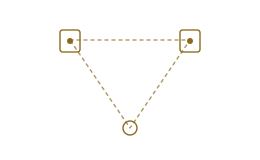
You and the two loudspeakers form a triangle. The most effective one is equilateral: the distance between the two speakers equal to the distance from each of them to your head. Spread them wider and the image opens but hollows out in the middle; bring them closer and it tightens but loses width.
Rule of thumb: start equilateral, then widen ten centimetres at a time until the voice in the centre begins to fray. Go back one step.
The wall behind
A nearby wall reinforces the bass, but at one precise frequency it also digs a hole: the reflected wave comes back late and subtracts from the direct one. The closer the speaker is to the wall, the higher that hole sits and the more you hear it.
Rule of thumb: avoid half distances chosen at random. From forty centimetres out things start to work, from eighty much better. If you can only give it twenty, it is better to push it right against the wall than to leave it halfway.
Symmetry
The two side walls should resemble each other. One speaker thirty centimetres from a wall and the other out in the room are two different instruments, and the ear notices before it understands why: the image drifts towards the more enclosed side.
Rule of thumb: the distance from the side wall must be the same for both, within ten centimetres or so. If the room does not allow it, better to turn the whole system ninety degrees.
The height
The axis of the tweeter — or of the single driver, if there is only one — must reach the ear of someone seated. Not someone standing. On a sofa with a forty-centimetre seat, the ear sits between 1.10 and 1.18 metres from the floor.
Rule of thumb: if the speaker is too low, tilt it back two or three degrees. If it is on a piece of furniture, the furniture is part of the problem — and often the first thing to change.

The subwoofer
You find it by walking.
The method is called the subwoofer crawl, and it sounds ridiculous until you try it. It works because below eighty hertz the ear can barely locate the source: what matters is not where the sub is, but how the room responds at that point.
- Put the subwoofer in your listening position, on the sofa, at the height your head would be.
- Play something with a continuous, recognisable bass line. Not a test track: a song you know.
- Walk slowly around the perimeter of the room, with your ear at the height the subwoofer would actually sit — so, crouching, which is the ridiculous part.
- Listen for where the bass is fullest and most even. Not loudest: most even, with no notes vanishing and others booming.
- That is where the subwoofer goes. Then set level and phase, looking for the most even integration with the main loudspeakers.
If the best spot is where the bookcase stands, you take the second best. But it is worth knowing which was first.
What not to do
Five mistakes that cost more than changing loudspeakers.
- Putting them in corners. A corner reinforces all the bass at once, without choosing: the result is swollen and slow.
- Recessing them into a niche or a bookcase. The niche has a voice of its own, and it puts it on top of the music.
- Standing them on furniture that vibrates. The furniture becomes a second loudspeaker, playing whatever it likes.
- Placing them at different distances from the side walls. It is the commonest mistake and the easiest to fix.
- Aiming them straight ahead when you sit off axis. A slight toe-in towards the listener recovers more than it costs.
Why we write this
A badly placed loudspeaker is not the loudspeaker's fault.
We would rather you heard properly what you already own, even if it is not ours. Helping your room sound better comes before the badge on the loudspeaker.